LANGUAGE

What scaffold couplers do in a tube-and-coupler system
Every tube-and-coupler scaffold stands or falls at its joints. Standards, ledgers, transoms, and braces are all plain steel tubes; the couplers are the fittings that clamp those tubes into a working structure. A typical high-rise facade scaffold uses thousands of them, and the type chosen for each joint decides whether the connection is rigid, adjustable, or load-rated at all. Buyers who treat couplers as interchangeable hardware usually discover the mistake during an inspection or a failure.
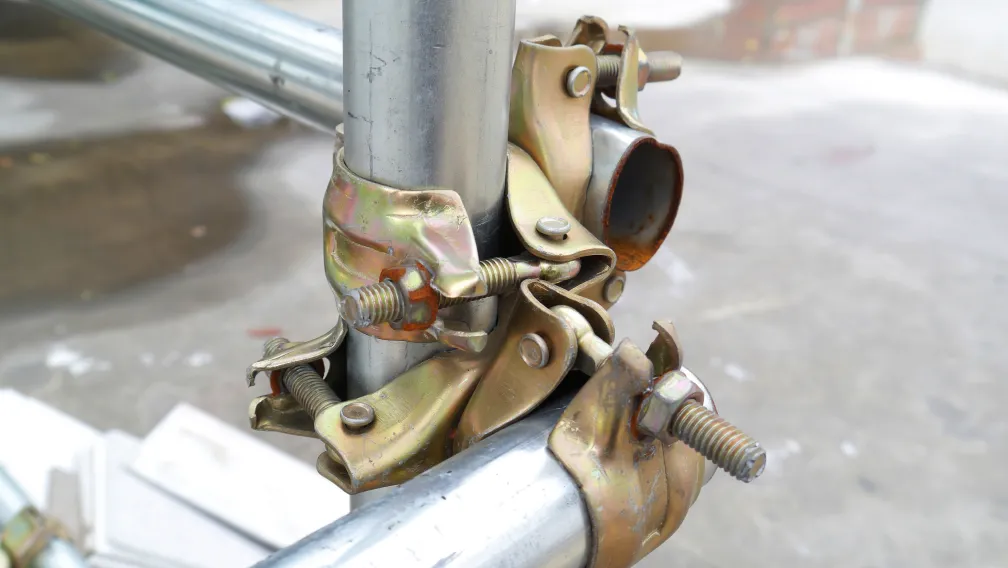
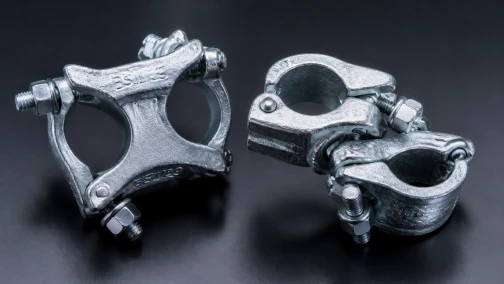
Direct answer: The main scaffold coupler types are the right-angle (double) coupler for fixed 90-degree joints, the swivel coupler for diagonal bracing, the putlog coupler for light platform connections, the sleeve coupler for end-to-end tube joints, the beam or girder coupler for attaching tubes to structural steel, and the board retaining coupler for holding scaffold boards. Right-angle couplers carry the structural load: EN 74 Class A is rated at 6.1 kN slip resistance and Class B at 9.1 kN. Load-bearing joints should always use drop-forged Class B couplers tightened to about 54 N·m.
The main coupler types and where each one belongs
| Coupler type | Joint it makes | Where it is used | Load role |
|---|---|---|---|
| Right-angle (double) | Fixed 90°, two tubes | Ledger-to-standard, transom connections | Primary load-bearing |
| Swivel | Any angle, two tubes | Diagonal braces, irregular geometry | Bracing only, not main load joints |
| Putlog (single) | Light 90° connection | Transoms and boards to ledgers | Light duty, 1.07-2.11 kN slip |
| Sleeve | End-to-end, external | Extending standards or ledgers in line | Alignment and moderate tension, ~9 kN slip |
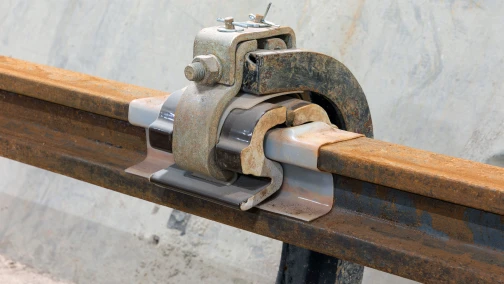
| Beam / girder | Tube to steel flange | Anchoring scaffolds to beams and girders | High load, flange clamping |
| Board retaining | Board restraint | Locking scaffold boards against uplift and slip | Safety component, not structural |
| Half | Single-tube fixing | Custom assemblies, temporary fixings | Secondary duty |
Two selection errors cause most coupler-related incidents. The first is using a swivel coupler where a double coupler belongs, because the swivel's pivoting halves cannot deliver the same rigid, high-slip-resistance joint. The second is treating putlog couplers as load-bearing fittings; at roughly 1 to 2 kN of slip resistance, they exist to locate boards and transoms, nothing more.
Right-angle vs. swivel: the two fittings that carry the structure
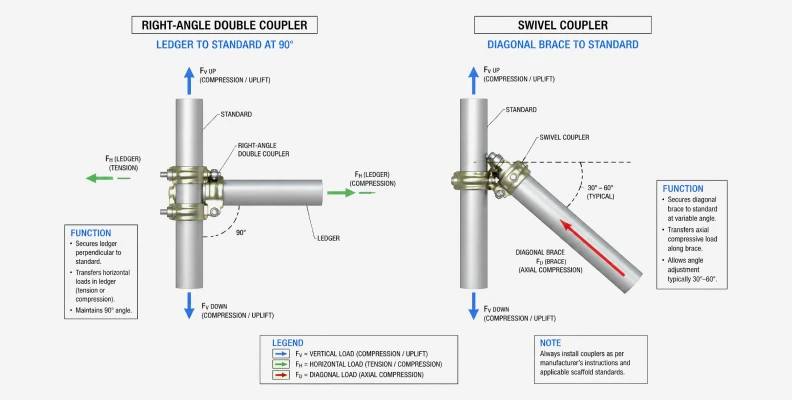
The right-angle coupler is the backbone of the system. Its two clamping halves hold tubes at a fixed 90 degrees, and both bolts work together to resist slip and rotation. This is the fitting that joins every ledger to every standard, so its rating sets the real capacity of the scaffold frame.
The swivel coupler looks similar but does a different job. Its halves rotate relative to each other, which lets it clamp a diagonal brace to a standard at whatever angle the brace runs. That flexibility is exactly why it should stay on bracing duty: a pivoted joint cannot replace a fixed one in the load path. Bracing with swivels, framing with doubles is the working rule on every compliant site.
Load ratings and EN 74 classes
Coupler capacity is defined by slip resistance: the load at which the clamped tube starts to move. Under EN 74 and BS 1139, the two figures buyers see most often are Class A at 6.1 kN and Class B at 9.1 kN for right-angle couplers. Class B adds stricter distortion limits on top of the higher slip rating, which matters on scaffolds that stay up for months and see repeated loading. Sleeve couplers in Class B reach about 9 kN slip resistance, while putlog couplers sit at 1.07 to 2.11 kN by design.
Tightening torque controls whether the coupler actually reaches its rated slip load. Site practice across British and European standards is about 54 N·m (40 lbf·ft) on the bolts unless the manufacturer states otherwise. Under-tightened couplers slip early; over-tightened ones crush the tube wall or strip the bolt. A calibrated torque wrench on random checks is a cheap audit tool.
Forged, pressed, or cast: how manufacturing route sets service life
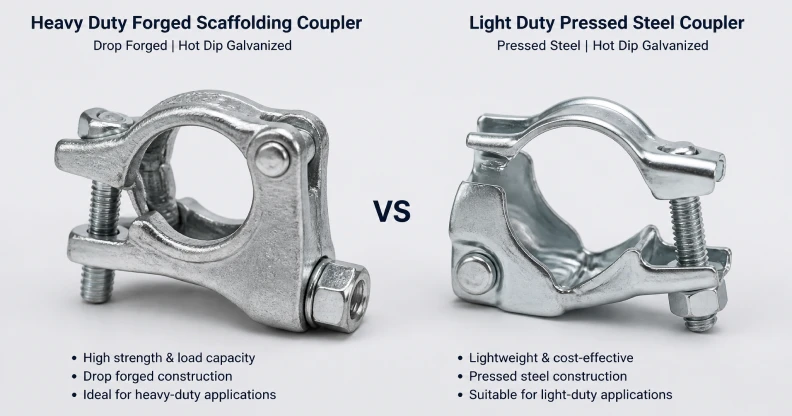
Drop-forged couplers are pressed from heated steel billets under high pressure, which produces a dense grain structure that resists impact, vibration, and repeated tightening. They are the standard choice for heavy-duty work on 4.0 mm wall tube, and their service life runs across many projects.
Pressed steel couplers are stamped from plate. The British type suits 3.2 mm wall tube scaffolds and medium-duty work; Japanese and Korean types are lighter still, matched to thin-wall systems of 1.8 to 2.4 mm tube. Sleeve couplers are almost always pressed steel because the part geometry suits stamping. Cast iron couplers cost the least but carry a real brittleness risk under impact, which is why most export specifications exclude them from structural joints.
For high-rise, infrastructure, and long-duration projects, drop-forged Class B fittings with grade 8.8 bolts are the defensible specification. Pressed couplers remain a rational choice for short-duration, light-duty scaffolds where the loads stay modest.
Tube size compatibility
The global standard is the 48.3 mm OD tube, and virtually every coupler in international trade is built around it. Within that diameter, wall thickness changes the duty: 4.0 mm tube with forged couplers for heavy work, 3.2 mm tube with British pressed couplers for medium duty. Non-standard diameters exist for specific systems, including 42 mm frame poles and 60 or 76 mm shoring legs, and couplers for these must be ordered to size because clamps do not tolerate diameter mismatch. A coupler that does not grip the full circumference will slip well below its rating.
Weight is a quick field check on what you were actually shipped. A British pressed fixed coupler weighs about 0.85 kg, while a light Japanese-type fixed clamp comes in near 0.65 kg. The two look similar in a photograph, so on mixed shipments, weighing a sample against the quoted specification catches substitutions before the fittings reach the scaffold.
Finish and corrosion protection
Zinc-plated (electro-galvanized) couplers suit ordinary site conditions and indoor storage. Hot-dip galvanized couplers cost more but hold up in coastal salt air, tropical humidity, and long outdoor storage, which describes most export stock. Corrosion is not only cosmetic on a coupler: rust on the threads raises the torque needed to reach clamping force and rust under the clamp reduces grip. For stock that will sit in a yard between projects, HDG pays for itself in avoided rejections.
Inspection and reuse between projects
Couplers are among the most reused components on any scaffold, and each reuse should follow a check. Reject fittings with bent or cracked bodies, stripped or stretched bolts, threads that jam or slip, heavy rust or pitting, and any coupler that no longer closes fully on a clean tube. Lubricated threads and dry storage between projects keep rejection rates low. Keep in mind that board retaining couplers and beam clamps see the same duty cycle and deserve the same inspection discipline, since a slipping board or a loose beam anchor fails without warning.
Procurement checklist for B2B buyers
- State the standard and class. EN 74 / BS 1139, Class B for load-bearing joints, with test certificates per batch.
- Specify the manufacturing route. Drop-forged for structural joints; pressed acceptable for light-duty and sleeve fittings.
- Fix the bolt grade. Grade 8.8 tee bolts and nuts on forged couplers; weak bolts waste a strong body.
- Match the tube. Confirm 48.3 mm OD and the wall thickness your scaffold design assumes.
- Set the finish. Hot-dip galvanized for coastal, tropical, or yard-stored stock; zinc plated for controlled conditions.
- Plan quantities by joint type. A standard bay count works out to roughly four doubles and a share of swivels per lift; order boards retainers and beam clamps against the actual layout, not a ratio guess.
Forged versus pressed steel: what the manufacturing route changes
Coupler pricing only makes sense once the manufacturing route is on the table, because the same envelope drawing can hide two very different products. Drop-forged couplers are hammered from heated steel billets into closed dies, which aligns the grain flow with the fitting's stress path and produces the densities that achieve EN 74 class B ratings - the 9.1 kN slip figure for double couplers comes from this process. Pressed-steel couplers are stamped from sheet, which is faster and cheaper, and produces a lighter fitting whose slip resistance typically lands in the class A range around 6.1 kN. Neither is defective; they are different classes serving different duty. The failure mode buyers should guard against is the silent substitution: pressed couplers quoted and shipped against a forged specification, or mixed batches where only the sample sent for approval was forged. The check is simple - forged couplers carry raised lettering and a characteristic parting line, and they weigh measurably more per piece than pressed equivalents at the same size. A random weigh-in of one percent of a shipment, against the quoted unit weight, closes the substitution door for the cost of a bathroom scale.
The 48.3 mm standard and what happens when tubes do not match
Nearly every coupler in international trade is built for 48.3 mm outside diameter tube, and the system's safety figures assume that match. Trouble starts when regional tube stocks drift from that standard: 48.6 mm tube from some Asian mills, or older imperial sizes, sit fractionally loose in a 48.3 mm fitting, and a loose coupler slips at a fraction of its rated load because the jaws never bite the tube wall fully. The purchasing rule is to verify the tube diameter of the project before confirming the coupler order, not after. Where a project runs mixed tube - common when new material meets a legacy fleet - the inventory and the coupler issue should be separated by diameter, and mixed-diameter connections rejected at inspection. A coupler that cannot close fully on the tube in front of it is not a tight fit; it is the wrong fitting, and the difference shows up as slippage under the first real load.
Estimating coupler quantities from the scaffold volume
Couplers are bought in the thousands and counted late, which is why shortages stall erection. A working estimate starts from the connection count, not the tonnage: each standard-to-ledger intersection takes one double coupler, each diagonal brace or guardrail return takes a swivel, each tube joint in length takes a sleeve coupler, and board and toe-board positions take their retaining fittings. For a tube-and-coupler facade scaffold, field experience puts the total at roughly five to seven fittings per cubic meter of scaffold volume, with double couplers accounting for about two-thirds of the count. Worked the other way, a 10,000 m² facade at five lifts of height involves tens of thousands of connections, and the order should carry the five-percent attrition allowance for dropped, lost, and rejected pieces on top. Buyers who price a project on tubes and boards and treat couplers as an afterthought discover that the fittings represent a quarter of the hardware value and all of the schedule risk.
Marking, traceability, and the EN 74 test family
EN 74 is not one test but a family, and the certificate worth having names them. For double and swivel couplers the governing figures are slip resistance along the tube and across it, plus pull-apart resistance; sleeve couplers carry their own tension requirements around 9 kN; and each class mark - A or B - corresponds to defined test levels. A compliant fitting is durably marked with the standard reference, the class, and the manufacturer's identification, so any inspector on any site can read its rating off the steel itself. At delivery, sample the markings before accepting the lot: unmarked couplers, or markings that name a standard without a class, cannot be placed into a rated scaffold without an assumption you have no basis to make. Keep the batch certificate with the site file, and the random re-test habit - sending a few fittings from each major delivery to a lab for slip verification - converts the certificate from paper into verified fact for a few hundred dollars per project.
Corrosion protection for fittings that live outdoors
Couplers spend their working life clamped to wet steel in the weather, and their failure by corrosion is quiet: the fitting still looks like a coupler long after the jaw profile and the bolt threads have thinned past their rating. Hot-dip galvanized bodies and bolts are the export default for a reason - the coating protects the jaw faces that paint never survives on, and keeps the T-bolt threads adjustable for years. Electro-galvanized fittings shine in the crate and rust in the first rainy season; they belong to indoor or single-project duty. Between projects, the maintenance that extends fitting life is mundane and cheap: wire-brush the jaws, oil the threads, and store the fittings dry and off the ground. Rejection criteria should be written and visual - thinned jaw walls, elongated bolt holes, cracked bodies around the hinge, and bolts that no longer hold torque are all scrap signals, and a tagged-quarantine bin on site keeps rejected fittings from drifting back into circulation.
Sleeve couplers and the joint problem
Every long tube run eventually needs a joint, and the sleeve coupler is the fitting built for it. Unlike the double and swivel fittings that handle intersections, the sleeve coupler joins tube ends in line, and its rating - tension values around 9 kN for compliant fittings - is what lets a joined standard carry load like a continuous tube. The installation detail that decides whether that rating is real is the joint position: sleeves belong away from ledger intersections, staggered so adjacent standards never joint at the same lift, and tightened with the tube ends butted so the fitting carries alignment rather than gap. A run of standards jointed carelessly at one level creates a hinge line across the scaffold that no bracing fully cures. On procurement, sleeve couplers are a small line on the order and a large factor in erection speed, since tube that arrives in transportable lengths only becomes full-height standards through them; under-order them and the site either stops or welds, and site welding of scaffold tube is a defect dressed as a solution.
Specialty fittings: beam clamps and board retainers in the system
The standard double and swivel fittings handle tube-to-tube geometry, but two specialty families complete most cantilever and facade systems. Beam clamps - girder couplers - grip the flange of a steel beam and give the scaffold a hanging point without drilling or welding the structure, which is exactly what cantilever tie-ins and edge protection on steel frames need; their rated capacities sit well below tube couplers, around 1.07 to 2.11 kN for putlog-style duty, so they belong in suspension and light attachment roles, not primary support. Beam clamps used as intended are a safe shortcut; used as primary support they are the classic and recurring misuse that experienced inspectors flag first. Board retaining couplers solve the quieter problem: boards lift in wind and underfoot, and a board retaining coupler locks the board to the ledger at a fraction of the cost of a displaced-board incident. Both families should appear on the same order as the main fittings, sized to the project count, because a shipment that arrives with ten thousand couplers and no board retainers has solved the structure and left the walking surface to chance.
Torque discipline: the number written on the wrench
A coupler reaches its rated slip resistance at a specified tightening torque - 54 N·m is the figure most standards and manufacturers converge on for 48.3 mm fittings - and both directions of error carry cost. Undertightened fittings slip at a fraction of their rating and are the everyday cause of leaning braces and gapping platforms; overtightened fittings crush the tube wall locally, strip threads, and crack pressed bodies, quietly manufacturing defects that surface later. The control is unglamorous: a calibrated torque wrench on site, spot checks of random connections during erection, and a rule that impact tools stop short of final torque. Crews that work to the wrench number produce scaffolds whose test certificates actually describe the structure standing on the site; crews that work by feel produce a structure that is only assumed to match them.
Receiving inspection: the fifteen-minute protocol
Fittings are small enough that entire deliveries can hide a problem, so the receiving protocol matters more for couplers than for any other scaffold component. Fifteen minutes per delivery covers it. Verify markings on a sample from each crate - standard, class, manufacturer. Weigh a counted sample against the quoted unit weight; a light batch is a wrong batch. Close a double and a swivel fitting on a scrap of the project tube and torque them to 54 N·m; fittings that will not close, or that slip by hand after torquing, fail the lot. And check the bolts: T-bolts should run freely on their threads, nuts should be self-locking or flanged as specified, and a handful of seized threads in the sample predicts thousands on site. Rejected lots go back with photos, weights, and the batch numbers recorded, which is also the documentation that makes the supplier's next delivery arrive correct.
Source tested couplers with your next scaffold order
Lengge manufactures the full coupler range, from drop-forged double and swivel couplers to sleeve, board retaining, and beam fittings, tested to EN 74 and BS 1139 with hot-dip galvanized finishes for export stock. Send us your tube specification, joint counts, and destination, and we will quote a complete fitting set with load test documentation. Reach the team through the contact page.
-

Lengge
Cantilever Scaffolding System Manufacturer
Lengge is a China-based factory producing cantilever I-beams, tie rods, couplers, embedded parts and full scaffolding accessories. We supply contractors, wholesalers and rental companies in over 50 countries from our own production facility in Hebei.