LANGUAGE

What an adjustable steel prop does on a concrete site
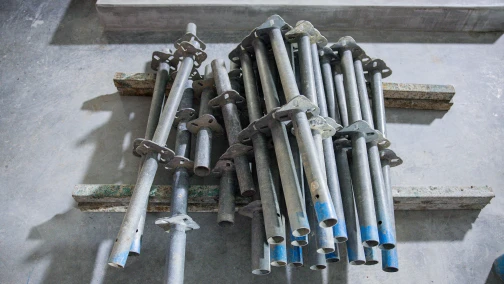
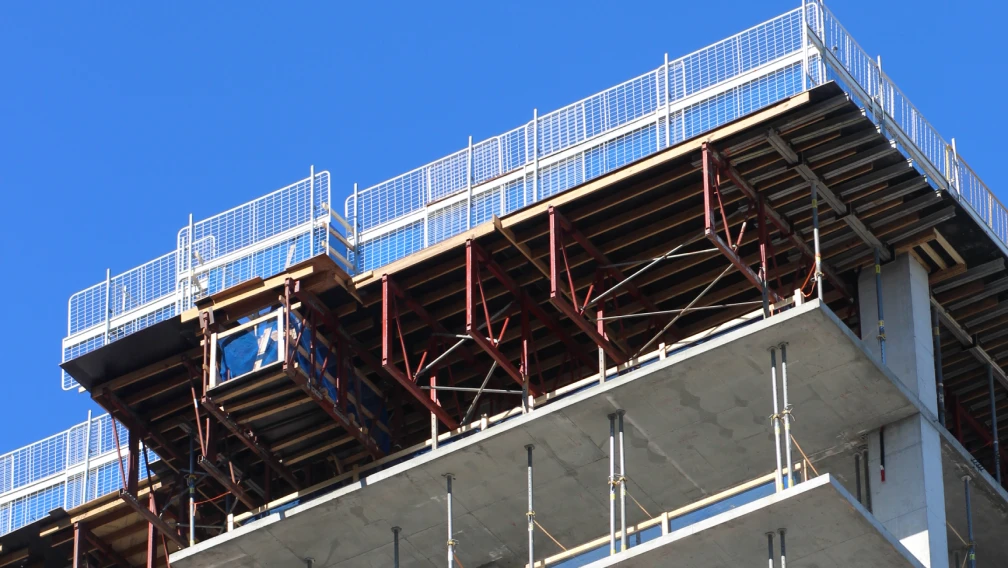
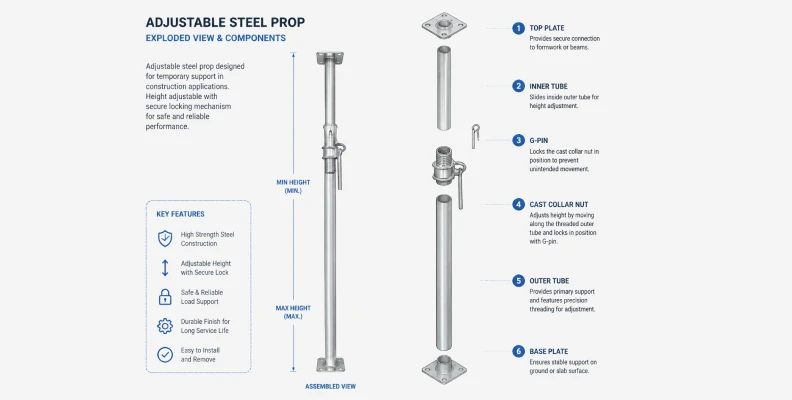
Wet concrete cannot hold itself up. Between the pour and the day the slab reaches working strength, the entire weight of concrete, formwork, workers, and equipment sits on temporary vertical supports. On most sites that support is a line of adjustable steel props, also called acrow props or shoring props. The mechanism is simple: an inner tube slides inside an outer tube, a steel pin through matching holes sets the coarse height, and a threaded collar wound up the outer tube takes the prop tight under the load. One worker can erect a prop in under a minute, which is why props remain the default shoring method for slab formwork worldwide.
Direct answer: Adjustable steel props are telescopic steel tubes with a pin-and-thread height adjustment, used to support slab and beam formwork until the concrete reaches the required strength. Standard sizes to BS 4074 cover heights from 1.07 to 4.88 meters, and EN 1065 load classes run from roughly 10 kN up to 51 kN per prop. The safe working load always falls as the prop is extended, so the rating must be read at the actual working height, not taken from the top of the chart.
Standard prop sizes
Props are identified by their height range. The widely used BS 4074 size set covers the heights found on typical floor-to-soffit work.
| Size reference | Closed height | Extended height | Typical use |
|---|---|---|---|
| No.0 | 1.07 m | 1.82 m | Low soffits, beams, lintel work |
| No.1 | 1.75 m | 3.12 m | Standard residential floor heights |
| No.2 | 1.98 m | 3.35 m | Higher residential and commercial floors |
| No.3 | 2.59 m | 3.96 m | Commercial slabs, industrial units |
| No.4 | 3.20 m | 4.88 m | High bays, warehouses, tall formwork |
Closed and extended heights vary slightly between manufacturers, so confirm the exact figures on the props you order. One rule applies everywhere: pick the smallest size that comfortably reaches your working height. A prop working near the bottom of its range is stiffer and carries more load than the same prop wound out to its limit. Where standard ranges are not enough, heavy-duty series extend to 5.5 meters, and the right adjustable steel prop for a project is always the one whose load table covers your height and your load at the same time.
EN 1065 load classes and what the class mark means
For export work and any project with a European specification, props are rated to EN 1065, the standard for adjustable telescopic steel props. EN 1065 fixes the material, wall thickness, and testing method behind the number printed on the prop. Tube wall thickness must be at least 2.3 mm for class A props and 2.6 mm for classes B through E. The inner and outer tubes must overlap by at least 300 mm at full extension, and every prop must carry its load class as a permanent mark. The rated capacity includes a 1.5 safety factor against collapse.
The classes tell you how much load a prop holds at a given extension. A typical load chart reads like this.
| Class | Characteristic strength | Example rating at 3.0 m extension | Example rating at 4.0 m extension |
|---|---|---|---|
| A (light duty) | approx. 13-20 kN | 17.0 kN | 12.8 kN |
| B | approx. 12-27 kN | 22.7 kN | 17.0 kN |
| C | approx. 19-41 kN | 34.0 kN | 25.5 kN |
| D (heavy duty) | 34 kN | 34.0 kN | 34.0 kN |
| E (extra heavy) | 51 kN | 51.0 kN | 51.0 kN |
The A to C classes lose capacity quickly with height because the extended inner tube makes the prop more slender and more prone to buckling. D and E classes use heavier tube sections that hold their rating across the full extension range. When a buyer asks why two props of the same height differ in price, this table is usually the answer.
Working out prop spacing under a slab
Prop spacing comes from the formwork design, but the arithmetic is straightforward and every buyer should be able to check it. Take a 200 mm reinforced concrete slab. Concrete weighs about 24 kN per cubic meter, so the dead load is 4.8 kN/m². Add a construction live load of 1.5 kN/m² and formwork self-weight of roughly 0.5 kN/m², and the design load lands near 6.8 kN/m².
A prop with a safe working load of 15 kN at the planned extension can therefore support about 2 m² of slab. That gives a grid of roughly 1.2 m by 1.2 m with margin to spare. Thicker slabs, beam lines, and transfer levels raise the load per square meter and pull the grid tighter; thin slabs on light duty props allow wider spacing. The final layout always belongs to the formwork designer, but any quotation you receive should state the assumed grid and the prop rating behind it.
Erection rules that prevent formwork collapse
Most prop failures on site trace back to the same handful of erection errors, and all of them are avoidable.
- Set props plumb. A prop carries its full rated load only when vertical and centrally loaded. Guidance to BS 4074 derates capacity sharply once out-of-plumb exceeds about 1.5 degrees. Fork heads or U-heads that cradle the bearer remove eccentricity at the top.
- Give every prop a firm base. Base plates must sit on sound, level ground or on sole boards that spread the point load. A prop punched into fill or standing on debris will settle during the pour.
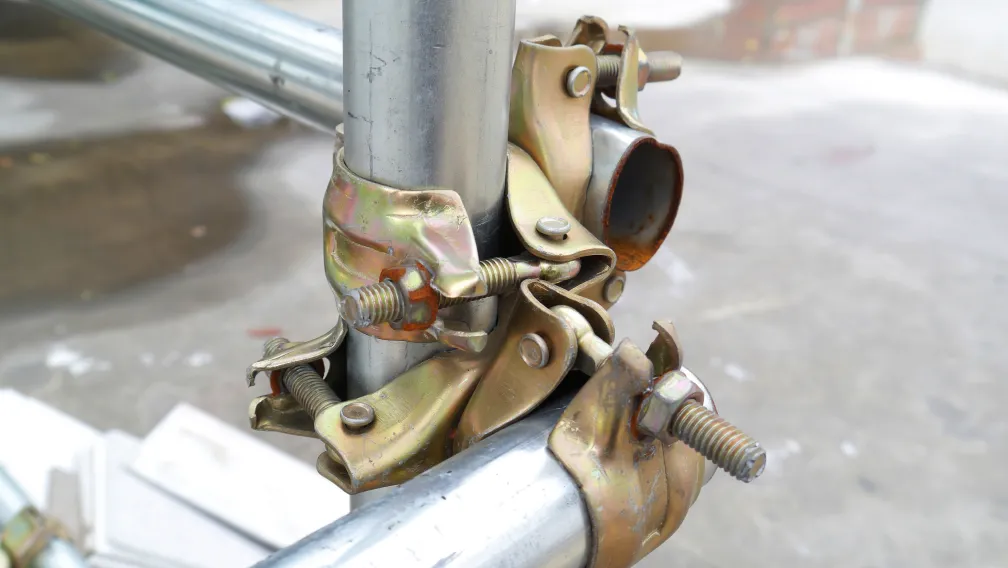
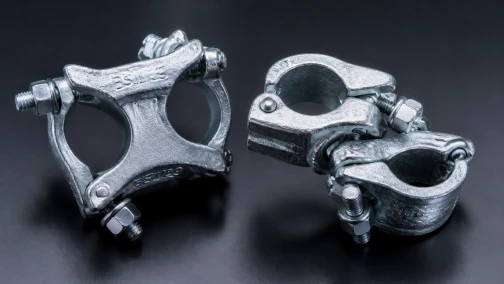
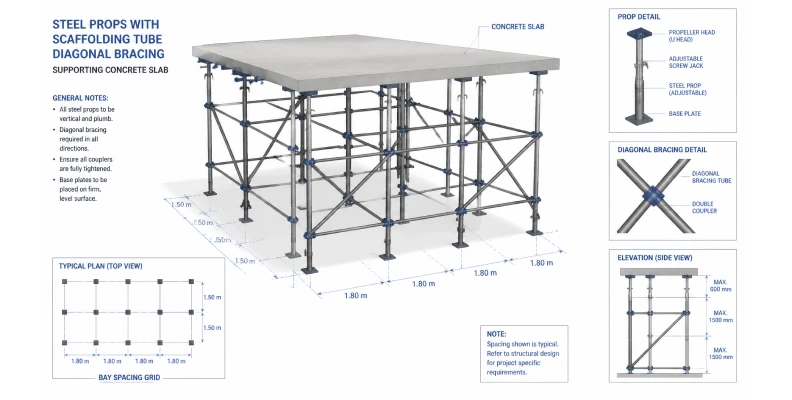
- Brace tall rows. Once props work above roughly 2.5 to 3 meters, or where the design calls for it, connect rows with scaffold tubes and swivel couplers as horizontal and diagonal bracing. Unbraced tall props can buckle as a group.
- Keep props vertical in service. Standard props are compression members. Using them at an angle, or as lateral supports without swivel-end push-pull units, removes most of their capacity.
- Stand props before loading. A prop tripod holds the unit upright while the collar is tensioned, and the final tightening should be snug, not hammered.
Inspection and rejection criteria
Props are reused across dozens of pours, and each reuse depends on the last inspection. Site guidance based on the structural engineering references rejects any prop showing these defects.
- A tube with a bend, crease, or visible lack of straightness
- Corrosion deeper than surface rust, especially pitting or flaking
- A bent head plate or base plate
- An incorrect or damaged pin, or a pin not attached to the prop by its chain or wire
- A collar nut that jams, slips, or shows stripped threads
Light surface rust is cosmetic and can stay in service. Anything that changes the tube's straightness or the thread's engagement is a structural problem, because both control how and when the prop buckles. Daily checks before each shift, bent inner tubes, missing pins, and cracked welds are the items experienced site managers look at first.
Stripping times and reuse
Props stay under a slab until the concrete can carry itself. The common reference point is a minimum of seven days at 20°C, extended in cold weather, with the engineer's stripping time as the governing instruction on every project. Back-propping, where a few props are replaced after the main grid is struck, lets formwork cycle faster while the young concrete continues to gain strength.
Between pours, props earn their money through maintenance. Concrete splatter cleaned off the threads, a light oil on the collar, and dry storage keep the adjustment working for years. Hot-dip galvanized props tolerate this cycle far better than painted ones in coastal or tropical climates, which is why export orders for Southeast Asia, the Middle East, and Africa increasingly specify galvanizing as standard.
What to specify when buying props for export
- Load class marked to EN 1065. The class must be permanently marked on the prop, with a test certificate behind it.
- Wall thickness. Confirm 2.6 mm minimum for classes B to E; underweight tube is the most common cost-cutting shortcut in the market.
- Rolled thread on the outer tube. Rolling keeps the wall thickness intact through the thread, while cut threads remove material exactly where the collar works.
- End type to match the job. Flat plate for general support, U-head to cradle bearers, push-pull for wall and column plumbing.
- Finish for the climate. Hot-dip galvanized for humid, coastal, or desert exposure; painted for indoor or short-cycle use.
- Packing by size. Bundles strapped and marked per size class, so the yard can count and issue props without re-measuring.
Matching prop size to slab height: the selection table in practice
Size selection starts from the clear height under the slab, minus the formwork and bearer build-up, and the prop should work in the middle of its adjustment range rather than at either extreme. The BS 4074 size series exists precisely for this: No.0 covers the lowest band around 1.1-1.8 m, through No.4 reaching roughly 3.2-4.9 m, with each size overlapping the next so most floor heights have two candidate sizes. When two sizes fit, the shorter prop working nearer its closed length is usually the better choice, because capacity rises as extension falls and a shorter column is stiffer against side loads. Sites mixing floor-to-floor heights - podiums, transfer levels, basements - should order against the tallest recurring height and accept slightly heavier props on lower floors, since one size family simplifies counting, bracing, and reuse. The full adjustable steel prop size and load table maps these bands against the EN 1065 classes, and it is the sheet to keep in the site office when the pour schedule is set.
Prop accessories that complete the shoring system
A prop alone is a jack; a shoring system is props plus the accessories that spread and brace their loads. U-head forks carry timber or steel bearers directly and are the default under beam bottoms; flat plates distribute load onto compacted ground or sole boards; tripod stands hold props upright during erection before the ledger frame stabilizes them; and frame bracing or tube-and-coupler lacing ties prop rows together so a single knocked prop cannot start a progressive collapse. The base condition deserves the same attention as the head: on soft ground, props sit on sole boards with their load spread, and on suspended slabs the load path down through the building has to be checked level by level. Buyers assembling a shoring package should price these accessories with the props, because a container of bare props with no U-heads or tripods is a half-system that the site will complete with improvisation.
How props fit the slab cycle: a weekly rhythm
Formwork economics run on the slab cycle, and props are the pacing item. In a typical residential cycle of one floor per week, the sequence repeats: set props and bearers, deck the formwork, pour, cure to striking strength, drop the props, and fly the set upward. The 7-day, 20-degree reference for striking vertical formwork under normal cement is where the "one week" rhythm comes from; colder weather or slower cement blends stretch it, and the decision belongs to cube or cylinder test results, not to the calendar. Back-propping extends the system downward: the fresh slab is supported while the slab below it is also propped, spreading the construction load across two or three levels, and the prop count for a floor therefore includes the back-props still standing below. Contractors who count only the active floor under-order by a third; the full cycle inventory is active floor plus back-propping floors plus a working spare set of around ten percent for damaged and repaired units.
Props, table forms, or frames: choosing the support system
Individual adjustable props are one of three ways to support a slab, and the choice follows the building's repetition and crane availability. Loose props with timber or aluminum bearers win where layouts vary floor to floor, where crane time is scarce, and where capital must stay low - the system is light, divisible, and tolerates irregular grids. Table forms - large pre-assembled deck panels with integrated props - win on repetitive rectangular floor plates with a free crane, trading a higher first cost for erection speed measured in minutes per table rather than days per floor. Frame shoring sits between the two: faster than loose props on regular grids, less crane-dependent than tables, but with fixed bay sizes that resist irregular layouts. Many contractors run a hybrid: tables or frames across the regular field of the slab, loose props at edges, cores, and transfer beams where the geometry breaks. The practical takeaway for buyers is that props are never obsolete in the mix - they are the universal adapter between systems, and the component that absorbs every layout exception the engineered systems cannot. For bracing connections between prop rows, rated swivel couplers on scaffold tube remain the standard hardware.
Corrosion protection and life expectancy on export projects
Props live half their life in wet concrete splash and half in yard storage, and the finish decides how many cycles they survive. Painted props are the budget option and perform acceptably indoors or on short programs, but paint fails fast where concrete paste and stripping tools attack it. Hot-dip galvanized inner and outer tubes cost more and routinely deliver a decade of site service, with the threads and adjustment holes staying workable long after painted equivalents have seized. The threaded portion is the wear item in any finish: grease it at every stripping, and reject props whose threads show stretched or corroded profiles, because thread failure under load drops the slab without warning. For buyers in coastal Middle East or tropical Southeast Asia climates, galvanizing is close to mandatory economics; the purchase price difference returns within two or three projects through avoided replacement.
Common field failures and how spacing discipline prevents them
Formwork failures involving props trace back to a short list of causes, and every one is a discipline failure rather than a product failure. Props out of plumb: a prop leaning five degrees loses a meaningful share of its rated capacity and walks further out under vibration; the fix is a plumb check per row during decking, not after the pour starts. Missing bracing: unbraced prop rows buckle as a group, which is why standards and ledger ties matter even when each prop individually looks stable. Over-extension: props run near maximum extension carry less than their headline rating, because EN 1065 capacities fall as extension rises; the load table per extension length, posted at the workface, is the control that prevents quiet overloading. And early stripping: dropping props before the concrete reaches strength transfers construction loads onto green slabs, cracking them in ways that appear in the defect list months later. Sites that hold toolbox talks on these four points measurably reduce both incidents and prop damage.
Reading an EN 1065 test certificate
The EN 1065 class mark is only as good as the test behind it, and buyers can verify both in a few minutes. A genuine certificate identifies the prop type by drawing or model number, states the tested extension lengths and the corresponding characteristic capacities, and names the laboratory with its accreditation. Cross-check three things against the delivered goods: the tube diameters and wall thicknesses on the certificate drawing versus a measured sample, the adjustment range, and the marking on the prop itself - EN 1065 requires durable marking of the manufacturer, type, and class on every unit. Certificates without an accredited laboratory, without extension-specific capacities, or carrying model numbers that match nothing in the crate are decoration. The same check applies to the claimed safety factor: class values already include the standard's own provisions, so a supplier quoting a separate "1.5 safety factor" on top of the class capacity is describing marketing arithmetic, not the standard.
Export specifications: threading, tolerances, and container planning
Prop export orders reward precision in three specification lines. Threading: rolled threads keep the tube wall intact and outlast cut threads, so the purchase order should name rolled threads rather than leaving the choice to price. Dimensional tolerances: outer and inner tube diameters, wall thickness (2.3 or 2.6 mm being the common pair), and the overlap engagement at full extension - 300 mm minimum is the working rule that keeps extended props stable. And packing: props nest by size and band into bundles that one worker can handle, with end caps or thread protection so the adjustment mechanism survives the voyage. A 40-foot container takes a substantial quantity when sizes are nested and bundled by height class, and a supplier who provides the loading plan with bundle counts per size saves the receiving crew a full day of sorting. Write all three lines into the purchase order and the shipment arrives as a system; leave them out and it arrives as scrap metal with potential.
A note on documentation closes the selection loop: keep the prop's test certificate, the size-and-class marking list, and the site spacing drawing together in the pour file for each floor. When an inspector or an insurer later asks why a given spacing was safe, that file answers in one step, and the answer traces directly to the rated product rather than to site habit.
Order props rated for your slab heights
Lengge manufactures adjustable steel props across the standard size classes, with U-head, plate, and push-pull configurations, hot-dip galvanized finishes, and load documentation for export orders. Tell us your floor heights, slab thicknesses, and quantities per size, and we will return a rated specification and quotation. Talk to our team through the contact page.
-

Lengge
Cantilever Scaffolding System Manufacturer
Lengge is a China-based factory producing cantilever I-beams, tie rods, couplers, embedded parts and full scaffolding accessories. We supply contractors, wholesalers and rental companies in over 50 countries from our own production facility in Hebei.