LANGUAGE

Why Chinese steel grades keep showing up on your mill certificates
Anyone importing structural sections from China will meet the same two designations on every mill test certificate: Q235 and Q355. They appear on beams, channels, angles, and fabricated parts alike, and they decide how much load the section can carry, how it welds, and what it should cost. Yet a surprising number of purchase orders still just say "structural steel," which leaves the grade decision to the mill. That is how a project specified for heavy beams ends up with light-duty material.
Direct answer: Q235 and Q355 are the two standard Chinese structural steel grades, named after their minimum yield strength in MPa. Q235 (GB/T 700) yields at 235 MPa with a tensile strength of 370 to 500 MPa, and suits general structures and light framing. Q355 (GB/T 1591-2018, which replaced Q345) yields at 355 MPa with a tensile strength of 470 to 630 MPa, and is the correct choice for heavy beams, long spans, and high-load members such as cantilever I-beams. Q235 corresponds roughly to S235JR or ASTM A36; Q355 corresponds roughly to S355JR or ASTM A572 Grade 50.
What the grade names actually mean
The Q stands for qu, the first letter of the Chinese word for yield. The number after it is the minimum yield strength in megapascals for material up to 16 mm thick. Q235 comes from GB/T 700, the standard for ordinary carbon structural steels. Q355 comes from GB/T 1591, the standard for low-alloy high-strength structural steels. The 2018 revision of GB/T 1591 renamed the old Q345 grade to Q355 to align Chinese designations with the European S355 series, so older drawings and certificates may still read Q345. It is the same material family.
Mechanical properties compared
| Property | Q235B | Q355B |
|---|---|---|
| Standard | GB/T 700 | GB/T 1591-2018 |
| Min. yield strength (t ≤ 16 mm) | 235 MPa | 355 MPa |
| Tensile strength | 370-500 MPa | 470-630 MPa |
| Min. elongation | approx. 25-26% | approx. 21-22% |
| Yield ratio behavior | Lower, more ductile | Higher, stronger per unit weight |
The gap that matters in design is the roughly 50% higher yield strength of Q355. A beam in Q355 carries about half again the load of the same beam in Q235 before permanent deformation starts. In practice that means a heavier duty can be met with the same section size, or the same duty can be met with a lighter section. Q235 answers back with better ductility and slightly easier forming and welding, which is why it remains the default for general fabrication.
Chemical composition and weldability
| Element | Q235B (max %) | Q355B (max %) |
|---|---|---|
| Carbon (C) | 0.20 | 0.20 |
| Silicon (Si) | 0.35 | 0.55 |
| Manganese (Mn) | 1.40 | 1.60 |
| Phosphorus (P) | 0.045 | 0.025-0.030 |
| Sulfur (S) | 0.045 | 0.025-0.030 |
Q355 gets its extra strength from a higher manganese allowance and, in many melts, small additions of microalloying elements such as niobium, vanadium, or titanium. Tighter phosphorus and sulfur limits improve toughness. Both grades weld readily with standard procedures. The practical difference shows up in thick sections: Q355's higher carbon equivalent calls for more discipline on preheat and heat input when welding heavy plate, while Q235 forgives almost any reasonable shop practice.
Yield strength drops as sections get thicker
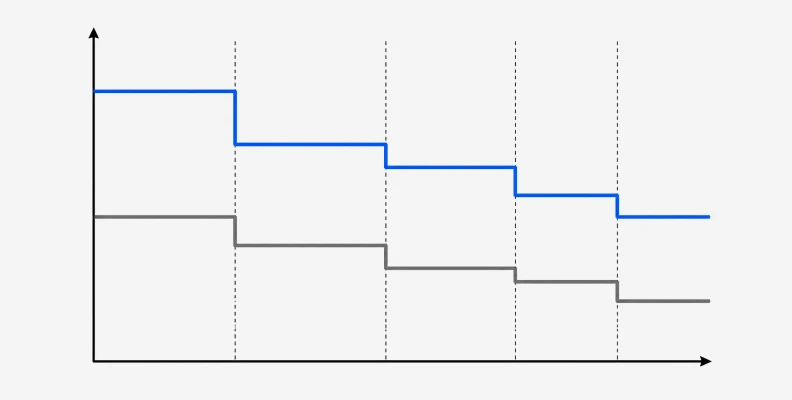
The headline numbers, 235 and 355 MPa, apply to material up to 16 mm thick. Both standards step the minimum yield down as thickness grows. For Q235, the guarantee falls through roughly 225, 215, and 205 MPa as thickness moves past 16, 40, and 60 mm. Q355 follows the same pattern, stepping down through 345 and 335 MPa in the middle thickness bands. This is standard behavior for hot-rolled steel, because thicker sections cool more slowly and develop a coarser grain. It matters at the buying table: if your beam design is checked at 355 MPa but the delivered flanges are 40 mm thick, the certificate value will legally read lower, and your design margin must account for that before the order is placed.
Quality levels A to E and impact testing
The letter after the grade sets the impact toughness requirement. Q235 runs from A to D: A has no mandatory impact test, B is tested at 20°C, C at 0°C, and D at minus 20°C. Q355 runs from B to E, extending to minus 40°C at level E. For outdoor structures in cold climates, or any member that sees dynamic loading, specify the level explicitly. A certificate reading Q235A tells you nothing about toughness, and that grade should stay out of load-bearing outdoor frames.
International equivalents
| Chinese grade | European (EN 10025) | American (ASTM) | Japanese (JIS) |
|---|---|---|---|
| Q235B | S235JR | A36 | SS400 |
| Q355B | S355JR | A572 Grade 50 | SM490 |
Equivalents are working references, not legal identities. The yield and tensile bands line up closely, but chemistry windows and impact test rules differ in detail between standards. When a project specification names an EN or ASTM grade, state the Chinese grade as the manufacturing reference and confirm acceptance criteria on the certificate rather than assuming interchangeability.
Which grade for which job
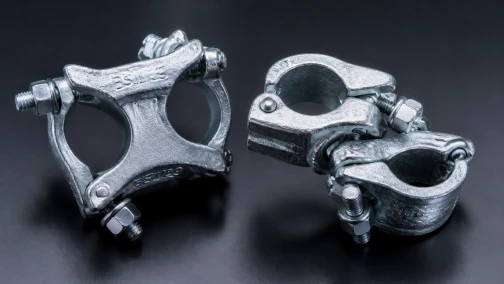
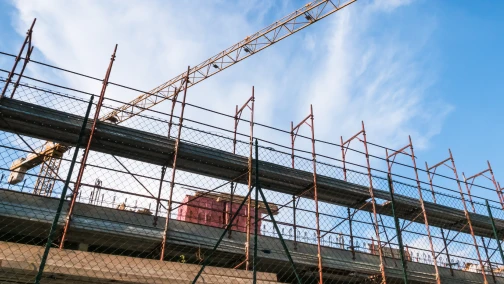
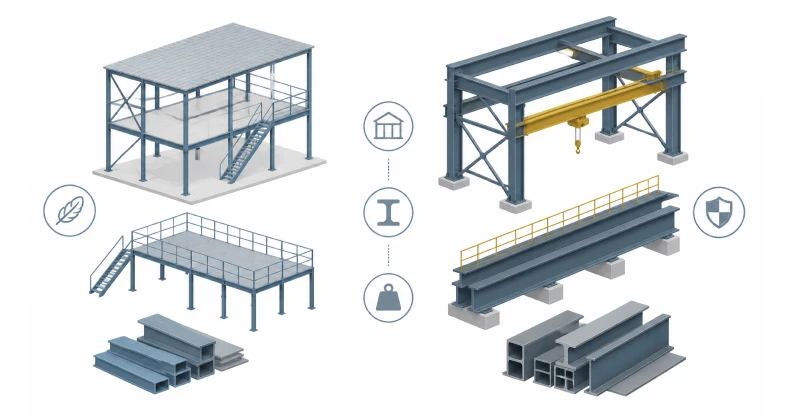
Q235 covers the large middle of construction: general frames, platforms, light purlins, bracing, and most scaffolding fittings. It machines, punches, and welds easily, and it costs less per ton.
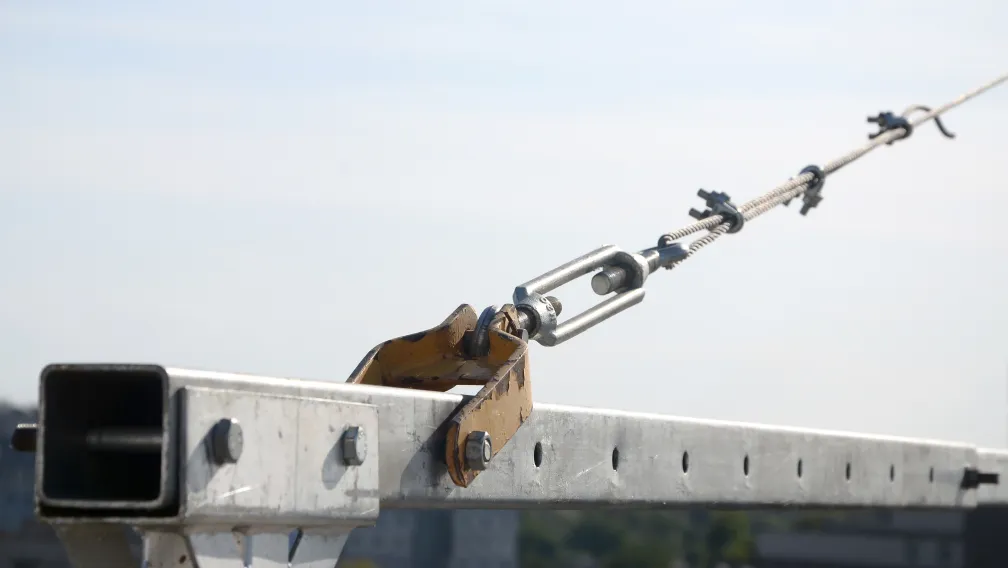
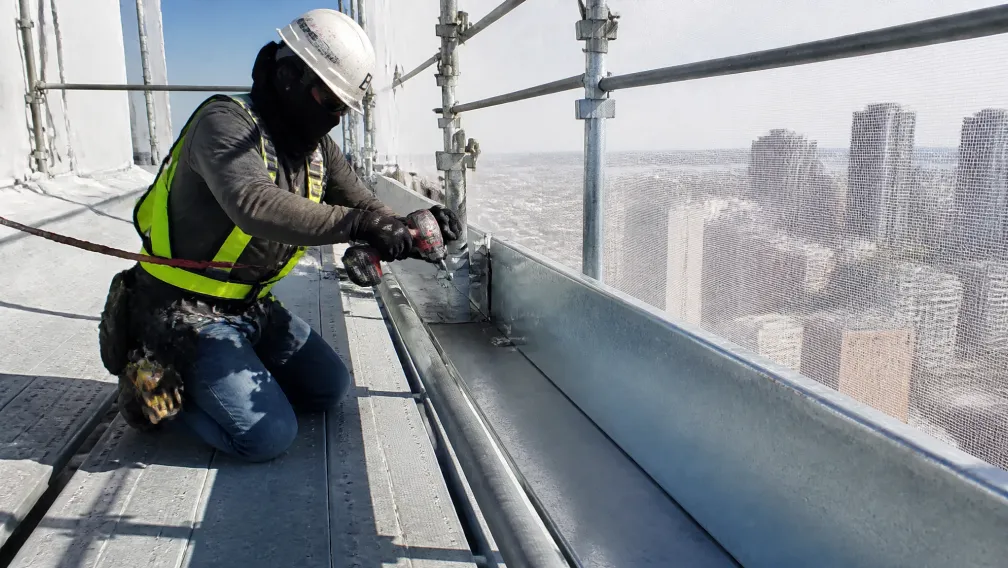
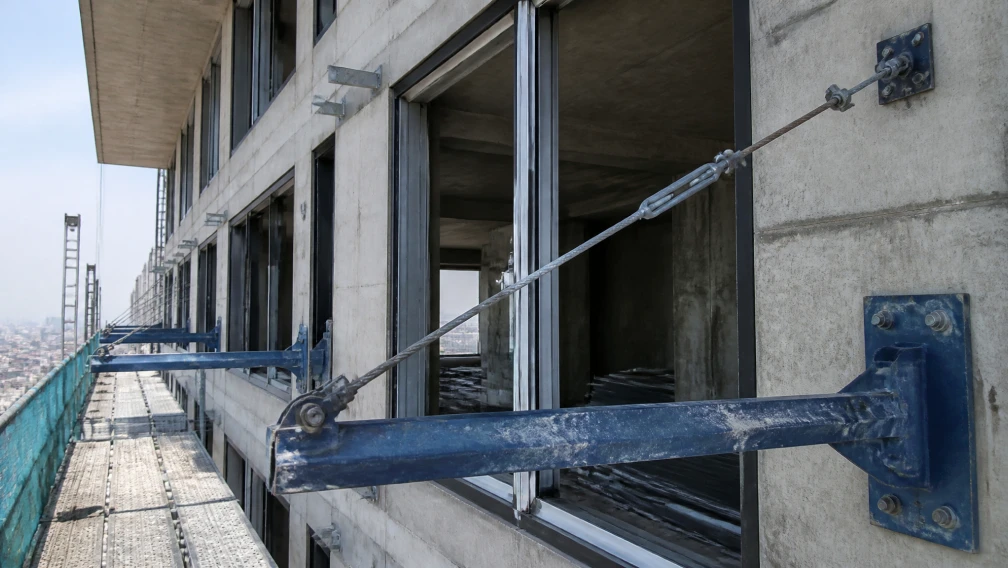
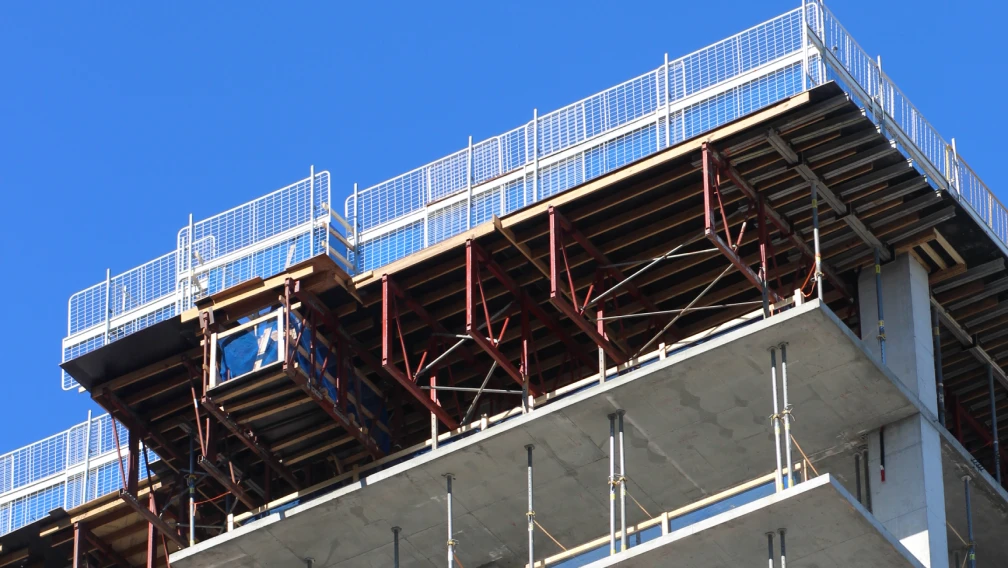
Q355 earns its premium where loads concentrate: long-span beams, crane runways, transfer structures, and heavy cantilever members. A cantilever I-beam holding a scaffold platform outside a high-rise face is a textbook Q355 application, because the section sees full bending stress at every cycle and self-weight directly affects handling. For super high-rise duty, heavy 18# sections in Q355 give the load margin that Q235 cannot reach at the same depth. When you source H-section steel for structural frames, the same logic applies: match the grade to the design load, not to the lowest quote.
How the grade behaves in fabrication
Downstream processing feels the grade difference too. Q235 cuts, drills, and cold-forms with minimal tool wear, which keeps fabrication cost low on parts like embedded plates, brackets, and light fittings. Q355's higher strength raises cutting force and punching tonnage modestly, and its springback is more pronounced in bending, so shops charge slightly more to process it. Hot-dip galvanizing works well on both grades; the zinc layer bonds to the same iron base, and the grade choice has no practical effect on coating quality. For fabricated assemblies that mix the two grades, weld procedure selection should follow the stronger material.
Common buying mistakes to avoid
Three errors recur in export orders. First, leaving the grade blank on the purchase order and accepting whatever the mill has in stock. Second, accepting "Q345" certificates on new contracts without noting the 2018 rename, which causes confusion at third-party inspection even though the material is legitimate. Third, comparing quotations per ton without checking which grade each price assumes, because a Q235 quote will always undercut a Q355 quote while delivering less capacity. A one-line grade clause in the contract prevents all three.
Price and procurement notes
- Expect a modest premium. Q355 typically prices about 5 to 10% above Q235 per ton. A gap far wider than that deserves a question about the source.
- Read the MTC, not the sticker. The mill test certificate should state the grade, the standard, the batch chemistry, and the mechanical results. Q235 substituted for specified Q355 is the most common grade fraud in export trade, and it only surfaces on the certificate or in testing.
- Specify the quality level. Write the full designation, for example Q355B, so the impact test requirement travels with the order.
- Ask for test reports per batch. Tensile and yield results should trace to the heat number marked on the material.
Reading a mill test certificate for grade verification
The mill test certificate - MTC, or 3.1 certificate in EN terms - is the only document that proves what the steel in front of you actually is, and reading it takes two minutes once you know the three blocks that matter. The heat number ties the certificate to one specific melt, and it should match the marking stenciled or stamped on the sections themselves; a certificate without a matching heat number on the steel is decoration. The chemistry block lists the ladle analysis - carbon, silicon, manganese, phosphorus, sulfur - and for Q355 the micro-alloy additions that produce the higher strength; values outside the standard's limits, or a certificate that lists only some elements, are grounds for question. The mechanical block shows the actual test results: yield and tensile values from that heat, plus elongation and, for quality levels B and above, the impact energy at the specified temperature. The habit that catches most problems is comparing the tested yield against the thickness band of your sections - a certificate quoting 355 MPa yield on 30 mm plate, where the standard steps down to 345 MPa, is either testing a different thickness or writing fiction. Certificates travel with the goods by right; a supplier reluctant to produce them before shipment is telling you something about the goods.
Weldability in practice: procedures for the two grades
Both grades weld well by structural steel standards, but they are not the same at the torch. Q235, with carbon typically under 0.22 percent and a low carbon equivalent, welds by any common process without preheat in normal ambient conditions - this is one reason it dominates general fabrication. Q355 carries a higher carbon equivalent thanks to its manganese and micro-alloy content, and the practical consequences show up as thickness grows: sections beyond about 25 mm, or welds under restraint or in cold weather, call for preheating in the 100-150 °C range, low-hydrogen consumables, and controlled interpass temperature to keep hydrogen cracking out of the heat-affected zone. For cantilever beam fabrication, where ear plates and end plates are fillet-welded to the section, the workshop implication is straightforward: Q235 kits weld on routine procedure, while Q355 kits deserve a qualified welding procedure with the preheat rules written in. A supplier who cannot state the welding procedure used on your Q355 fabrications has not controlled the most failure-prone step in the product's manufacture.
Impact testing and the temperature ladder
The quality-level suffix on Q355 - B, C, D, E - is a temperature ladder for toughness, and choosing the rung is a climate decision, not a paperwork one. Q355B verifies impact energy at room temperature (20 °C), Q355C at 0 °C, Q355D at minus 20 °C, and Q355E at minus 40 °C, each at 34 joules minimum for the common thickness range. Q235 offers the same ladder with fewer rungs commonly traded. The selection logic: structures in temperate and hot climates - the Middle East, Southeast Asia, Africa - work fine with B-level material, and paying for D-level toughness in Dubai is buying insurance against weather that will never occur. Cold-climate projects, high-altitude sites, and any application with dynamic loading in winter justify the climb up the ladder, because brittle fracture does not announce itself and the price difference between rungs is small against the consequence. The ladder appears on the MTC as the tested impact temperature, and a certificate silent on impact values means the material was sold as A-level - untested - whatever the purchase order assumed.
Galvanizing behavior and the silicon trap
Most exported scaffolding steel leaves the mill black and gets galvanized at the fabricator, and here the grades behave differently in a way few buyers expect. Hot-dip galvanizing reacts with the steel's silicon content: steels in certain silicon ranges produce excessively thick, brittle zinc layers that flake under handling - the Sandelin effect - while silicon-killed steels in the right range produce the smooth, adherent coating everyone wants. Q355, with its higher alloy content, needs its silicon specified for galvanizing when a coated finish is intended, and experienced fabricators order "galvanizing-grade" chemistry on the purchase order rather than discovering flaking after the zinc bath. The practical instruction costs one line in the specification: state that sections are intended for hot-dip galvanizing and require silicon content in the suitable range. It is the difference between a galvanized H-section that serves five projects and one whose coating peels at the first reload.
How the price difference forms and when it moves
The five-to-ten-percent premium of Q355 over Q235 is not a fixed number; it is a market spread that breathes. The base driver is alloy cost - the manganese and micro-alloys in Q355 cost real money per ton - but the traded spread widens when higher-grade demand runs hot, such as during infrastructure pushes, and narrows when mills discount to move higher-grade stock. For buyers, two habits follow. Quote both grades when the design allows either, because the spread occasionally compresses to the point where Q355 costs barely more and buys capacity margin essentially free. And fix the grade in the contract by standard and quality level - "Q355B to GB/T 1591-2018" - rather than by a generic "high-strength steel," because contract language is what decides the argument when a shipment of the wrong grade arrives. The same discipline applies to the older Q345 name still circulating in quotations: since 2018 it maps to Q355, but a certificate actually printed Q345 on recent material suggests old stock or loose paperwork, both worth a question.
Cutting, drilling, and machining: workshop differences between the grades
Fabrication cost follows the grade more than most quotations admit. Q235 shears, saws, drills, and punches with standard tooling at standard speeds, which is part of why fabricators like it. Q355's higher strength raises cutting forces and tool wear - drill bits dull faster, punching demands more tonnage, and flame-cut edges harden slightly, which matters where holes will be reamed or threads tapped afterward. None of this is prohibitive; it is simply cost that belongs in the fabrication quote rather than in a surprise line item later. For buyers ordering pre-drilled or pre-welded kits such as cantilever I-beams with connection holes and ear plates, the specification should state whether machining happens before or after any heat treatment and galvanizing, because hole quality at the connection is where fabrication shortcuts first become visible - elongated, torn, or misaligned holes concentrate stress exactly where the beam works hardest.
Regional standards and how export projects specify equivalents
International projects rarely write "Q235" or "Q355" on the drawings; they write the local equivalent, and the mapping is where procurement accuracy is won. European designs specify S235 or S355 to EN 10025, American designs A36 or A572 Grade 50 to ASTM, and Japanese projects SS400 or SM490 to JIS. Chinese mills export against all of these designations routinely, but the certificate must name the destination standard, not just the Chinese grade, because the test methods and required values differ in detail - impact temperatures, sampling positions, and reporting formats are not identical across standards. The safe contract language names the destination standard first and permits the Chinese equivalent by reference: "S355JR to EN 10025-2; Q355B to GB/T 1591-2018 accepted as equivalent with dual-certified MTC." Dual-certified material, tested and reported against both standards, eliminates the equivalence argument at customs, at the consultant's desk, and at any later dispute - and it costs the buyer nothing beyond asking for it at order time.
A worked selection: cantilever beams for a facade tier
Pulling the threads together on a real component makes the grade logic concrete. Consider the standard cantilever kit for residential facades: 16# or 18# I-beams at projections up to 1.8 m, carrying a 20 m scaffold tier. The calculation for the typical case resolves comfortably in Q235 - the deflection and moment demands sit inside the Q235 section's envelope, weldability is routine, and the price is lowest. Move the projection beyond 1.8 m, add material storage on the platform, or specify a longer service life with more reuse cycles, and the calculation starts pointing at Q355: the same section depth carries the higher demand, avoiding a jump to a heavier section that costs more in steel and freight than the grade premium. Cold-climate deployment adds the quality-level question on top - Q355C minimum where winter service temperatures drop below freezing. The lesson generalizes: grade selection is the last step of the structural calculation, not the first line of the purchase order, and buyers who ask suppliers to show the calculation basis get engineering; buyers who ask only for the cheaper grade get iron.
Standards evolve, and so should your specifications
GB/T 1591-2018 is not the last word. Chinese steel standards are revised on roughly ten-year cycles, and each revision can shift designations, impact requirements, or delivery conditions. A specification written in 2020 that references an outdated edition may be rejected by a careful mill or accepted loosely by a careless one, and neither outcome serves you. Assign someone to track the standards that govern your regular purchases, note revision dates, and update your templates when new editions publish.
The same vigilance applies to international equivalents. EN 10025 has been through multiple parts and amendments, and the mapping between Chinese and European grades is a matter of engineering judgment, not legislation. When a project specification cites an EN grade, confirm the edition year before assuming a Chinese equivalent. An S355 defined under an older edition may not match the current testing requirements, and the difference matters when a third-party inspector checks your certificates against the current standard.
Finally, treat certificate literacy as a skill worth training. The junior buyer who can spot a mismatched heat number, an implausible test date, or a tensile result suspiciously identical across five batches is protecting your projects more effectively than any after-the-fact dispute process. Counterfeit or recycled certificates exist in every steel market. A supplier who welcomes certificate verification questions, provides original mill contacts, and supports third-party retesting is telling you something about their confidence. One who deflects is telling you something too.
Order sections in the grade your design assumes
Lengge supplies H-section steel, cantilever I-beams, and fabricated scaffolding components in Q235 and Q355 with mill test certificates traceable to each batch. Send us your section sizes, required grade and quality level, and tonnage, and we will return a quotation with the documentation package included. Reach the team through the contact page.
-

Lengge
Cantilever Scaffolding System Manufacturer
Lengge is a China-based factory producing cantilever I-beams, tie rods, couplers, embedded parts and full scaffolding accessories. We supply contractors, wholesalers and rental companies in over 50 countries from our own production facility in Hebei.